
Images are everywhere: in our phones, medical systems, security cameras, autonomous vehicles, and many other applications. We often want a computer to look at an image and recognize what it contains. It might need to identify a handwritten digit, recognize a cat, locate a pedestrian, or separate an object from its background.
A traditional Artificial Neural Network (ANN) can be trained to perform image classification. However, directly applying a fully connected ANN to image data can be inefficient. Images contain spatial structure: each pixel has a location, and the arrangement of neighboring pixels carries important information.
This is where Convolutional Neural Networks (CNNs) become useful.
A CNN is a type of neural network designed to work particularly well with data that has a grid-like structure, such as images and certain kinds of time-series data. In this tutorial, we will build an intuition for what CNNs are, why they are useful, how they recognize patterns, and where they are applied.
1. What Is a Convolutional Neural Network?
A Convolutional Neural Network, commonly called a CNN or ConvNet, is a neural network architecture that uses convolutional operations to learn patterns from structured data.
Images are a natural fit for CNNs because an image can be represented as a grid of pixels. Each pixel has a numerical value, and its position relative to other pixels matters.
For example, a grayscale image can be represented as a two-dimensional grid:
12   18   22   25
15   20   90   94
17   24   88   91
10   16   19   23
These numbers represent pixel intensities. In a real image, the grid is usually much larger. A color image commonly has three channels—red, green, and blue—so its representation has height, width, and channel dimensions.
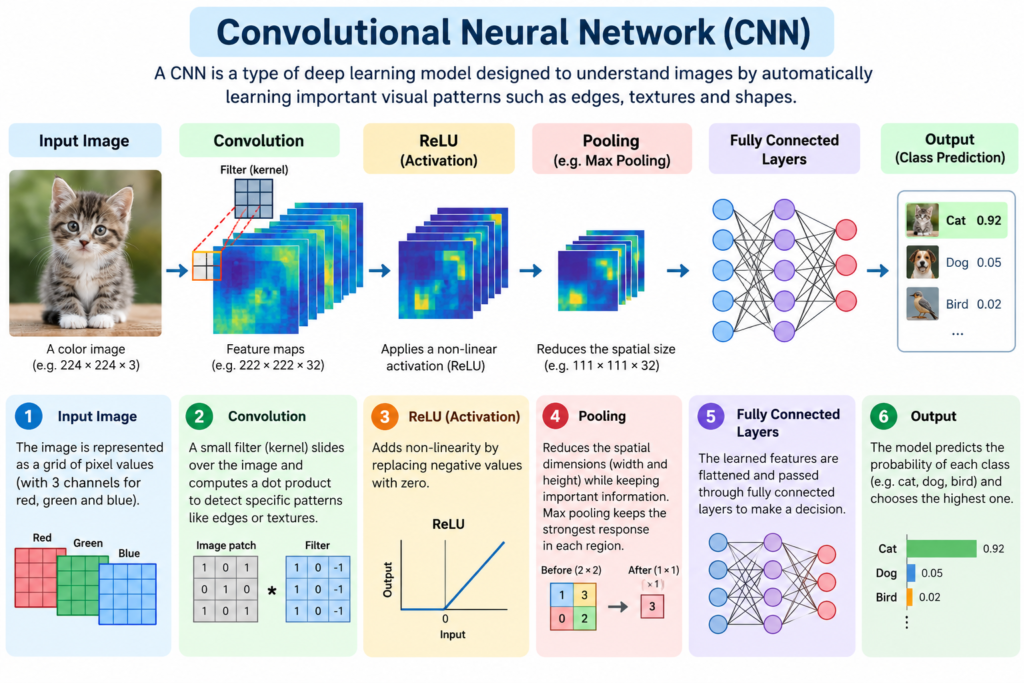
A CNN learns patterns from this arrangement instead of treating every pixel as an unrelated number.
2. Why Do We Need CNNs?
You might reasonably ask: if we already have Artificial Neural Networks, why introduce another architecture?
We can flatten an image into a one-dimensional list of numbers and pass that list into a fully connected ANN. This can work, and ANNs have been used for image classification. But it creates several difficulties as image size grows.
2.1 High computational cost
Imagine a small grayscale image with dimensions . It contains:
pixel values.
If we flatten it, the input layer has 1,600 values. If the first hidden layer contains 100 neurons, a fully connected layer needs:
weights, not counting biases.
That is only the first layer of a very small example. Larger images and wider layers can require far more parameters and computations.
A CNN uses small filters that scan local regions of an image. The same filter weights are reused across different positions. This weight sharing can dramatically reduce the number of parameters needed to detect a pattern across an image.
2.2 Overfitting risk
A fully connected ANN can learn many relationships between individual pixels and its output. With limited training data, it may learn details specific to the training images rather than patterns that generalize to new images.
This is called overfitting.
CNNs do not automatically prevent overfitting, but their local connections and shared filter weights introduce useful structure. They encourage the network to learn reusable visual patterns, often making them a more effective choice for image tasks.
2.3 Losing spatial relationships
An image is not just a bag of pixel values. Where each pixel appears matters.
For example, when recognizing a face, the relative positions of the eyes, nose, and mouth are meaningful. If we flatten an image, the numerical input still contains the pixel values, but the network is not explicitly designed to take advantage of their two-dimensional neighborhood structure.
A CNN processes local regions of the image and preserves spatial structure through its feature maps. It can learn that nearby pixels form edges, that edges form shapes, and that shapes combine into larger objects.
The key idea is:
CNNs are designed to learn useful visual patterns while taking advantage of the spatial arrangement of pixels.
3. An Intuition: How Do We Recognize a Handwritten Digit?
Suppose we want to recognize the digit 9. The digit may be written in many different ways:
- The loop may be wide or narrow.
- The tail may be straight or curved.
- The digit may be tilted.
- The handwriting may be thick or thin.
A useful classifier must recognize the digit even when its appearance changes. Humans do something similar. We do not need every pixel to match a memorized image. We recognize visual patterns: curves, lines, loops, and how those parts are arranged. A CNN learns a hierarchy of patterns.
Pixels
  ↓
Simple edges and lines
  ↓
Curves and corners
  ↓
Parts of a digit, such as a loop or tail
  ↓
Combination of parts
  ↓
Prediction: 9
This is an intuition, not a strict rule that every layer learns exactly one type of feature. In practice, learned features overlap and vary with the model and training data. However, the hierarchy is a useful way to understand why CNNs work.
4. The Main Parts of a CNN
A common introductory CNN contains three broad kinds of layers:
- Convolutional layers extract features from the input.
- Pooling layers reduce the spatial size of feature maps and help make representations more compact.
- Fully connected layers use the extracted features to make a final prediction in a traditional classification architecture.
A simplified architecture looks like the image shown earlier in this tutorial.
Not every modern CNN uses exactly this sequence. Some architectures omit pooling, use global average pooling, or use other classifier heads. This diagram represents a common basic design.
5. Convolution: Looking for Patterns
The convolutional layer is the defining component of a CNN. It applies small arrays of learnable values, commonly called filters or kernels, to local regions of the input. As a filter moves across the image, it calculates responses that indicate how strongly a particular pattern appears in each region.
Imagine a filter that responds strongly to a vertical edge. When it scans an image, it may produce strong responses where vertical edges occur and weaker responses elsewhere.
The filter values are generally learned during training. We do not usually hand-design every filter in a modern CNN.
5.1 What is a feature map?
A feature map is the output produced when a filter is applied across an input. For example, a filter that learns to detect a particular edge may produce a feature map with high values around locations where that edge appears.
A CNN typically learns many filters. Different filters can respond to different patterns, so one convolutional layer can produce multiple feature maps.
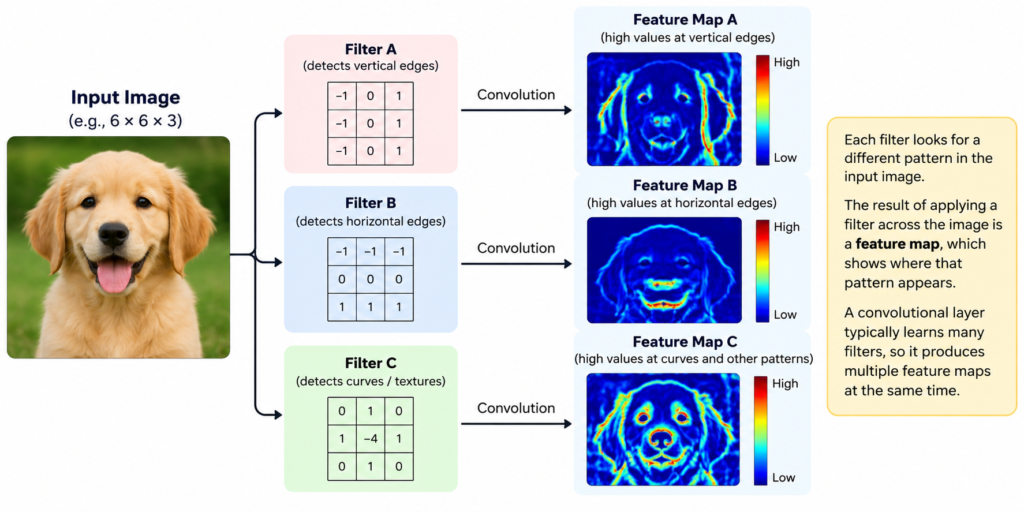
These labels are illustrative. The network learns what each filter responds to from the training data.
5.2 Why is convolution different from a fully connected layer?
A fully connected layer connects each input value to each neuron in the next layer. A convolutional layer instead uses local connections and reuses the same filter weights at multiple positions.
This creates two useful properties:
- Local connectivity: each filter examines a small region at a time.
- Weight sharing: the same filter can detect a learned pattern in different parts of the image.
For instance, an edge detector can be useful whether the edge appears near the top, center, or bottom of an image. This is one reason CNNs are effective for visual data.
6. A Hierarchy of Features
CNNs often build increasingly complex representations across layers. An early layer may respond to simple patterns such as edges, color transitions, or basic textures. Later layers can combine these responses into more complex structures.
For a handwritten digit, a simplified progression might be:
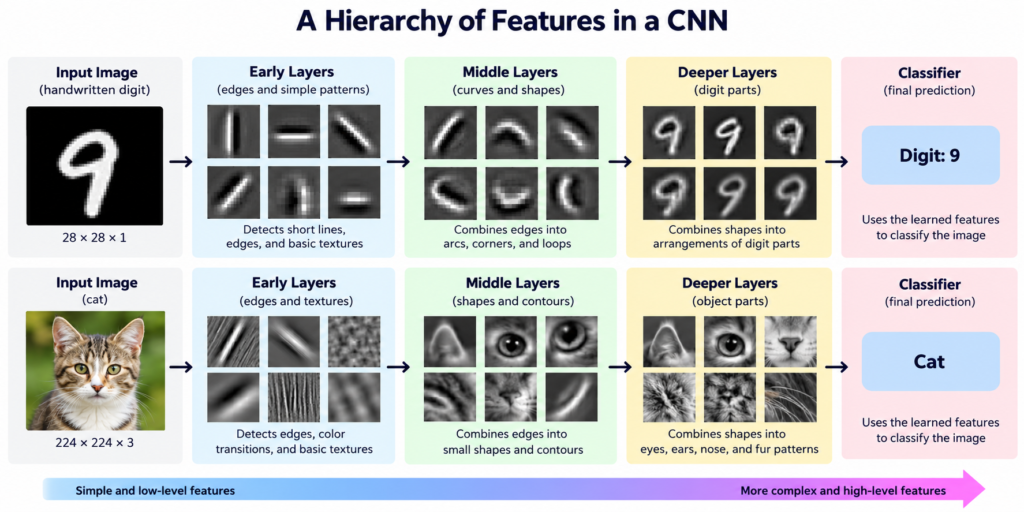
These are illustrative descriptions rather than guaranteed interpretations of individual layers. A CNN does not necessarily dedicate one neuron or layer to a human-readable concept such as “ear.” The useful representations are learned from examples.
7. Pooling: Reducing Spatial Size
A pooling layer reduces the spatial dimensions of a feature map. One common operation is max pooling, which takes the maximum value within a small region.
For example, consider a region:
1   5
2   3
Max pooling returns:
5The maximum response is retained from that region. Pooling can reduce the amount of data passed to later layers and can make the representation less sensitive to small shifts in the exact position of a feature.
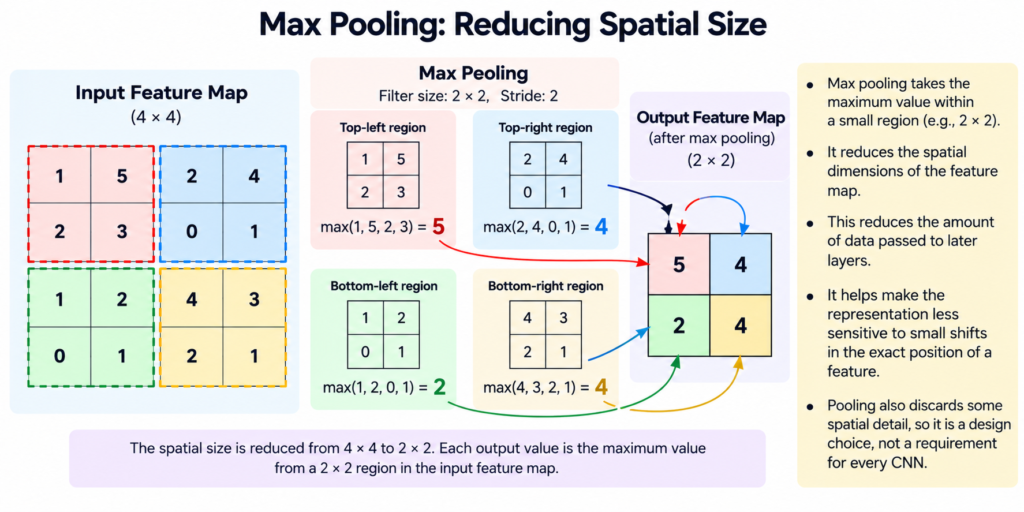
However, pooling also discards some spatial detail. It is therefore a design choice, not a requirement for every CNN. Some architectures reduce spatial size using strided convolutions or other operations instead.
8. Fully Connected Layers: Making the Prediction
After convolutional and feature-reduction stages, a basic CNN classifier converts the extracted representation into class scores.
For example, a model trained to classify animal images might produce scores for:
Cat
Dog
Horse
Zebra
The classifier uses the features extracted by the earlier layers to decide which class is most likely.
A traditional architecture may flatten the feature maps into a one-dimensional vector and pass it to fully connected layers. Other architectures use global average pooling or different classifier heads.
The output layer may use a softmax function when the task is single-label classification. Softmax converts class scores into values that sum to one, which can be interpreted as model probabilities—though those probabilities are not guaranteed to be perfectly calibrated.
Example output:
Cat       0.08
Dog       0.04
Horse     0.03
Zebra     0.85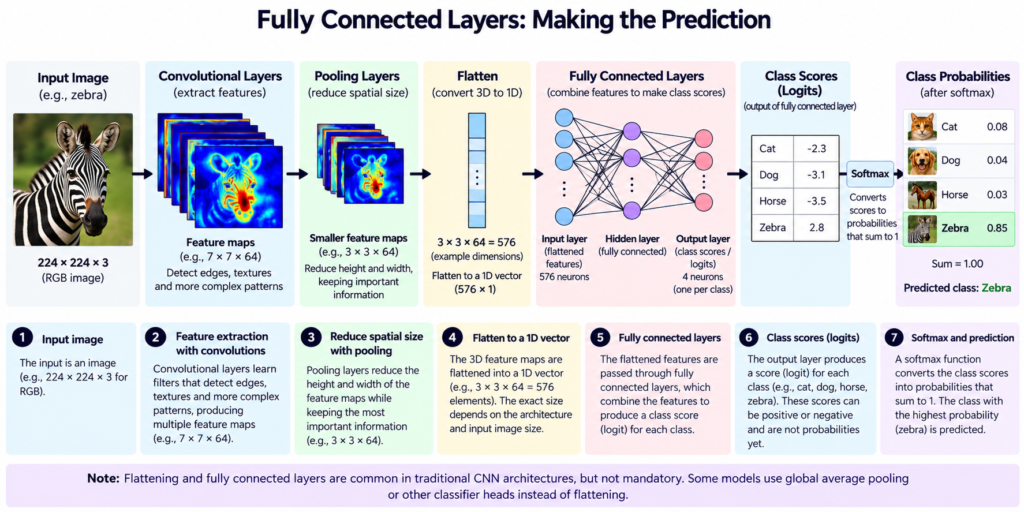
In this illustrative example, the model predicts zebra because it has the highest score.
9. CNN vs. a Fully Connected ANN
Both CNNs and fully connected ANNs are neural networks, but they use different connectivity patterns.
| Aspect | Fully connected ANN | CNN |
|---|---|---|
| Connections | Each neuron connects to all values in the previous layer | Convolutional filters connect to local regions |
| Weight use | Weights are generally distinct for different connections | Filter weights are reused across spatial positions |
| Spatial structure | Not explicitly built into a flattened input | Exploits local spatial structure |
| Image processing | Can classify images, but may be parameter-heavy | Often well suited to image tasks |
| Typical operations | Matrix multiplication and activation functions | Convolution, activation, often pooling, and classification layers |
A CNN is not simply an ANN with a different name. It is a neural network architecture with a structure designed to exploit spatial patterns. At the same time, CNNs still use matrix and tensor operations internally. The distinction is not that ANNs use mathematics while CNNs do not; convolution is itself a mathematical operation.
10. A Short Historical Note
CNNs were inspired in part by research into how biological visual systems process information.
A major milestone was LeNet-5, introduced by Yann LeCun and colleagues in the 1990s. It demonstrated the practical value of convolutional networks for tasks such as handwritten digit recognition, including reading digits on checks.
Later work, including AlexNet in 2012, helped bring deep CNNs to wider attention for large-scale image recognition. Architectures such as VGG, ResNet, and Inception further developed CNN design.
The broader lesson is that CNNs became successful because their structure matched important properties of image data and because improvements in data, hardware, and training methods made larger models practical.
11. Where Are CNNs Used?
CNNs are used in many computer-vision tasks. The following are distinct tasks, even though CNNs may be components of systems that solve them.
11.1 Image classification
The goal is to assign an image a label.
Examples:
Input image → cat
Input image → container ship
Input image → motor scooter
Input image → leopard
The model predicts a class for the image as a whole.
11.2 Object localization
Object localization asks where a particular object is in an image. A system may predict a bounding box around the object.
11.3 Object detection
Object detection identifies and locates one or more objects. A detector typically outputs class labels and bounding boxes, often with confidence scores.
For example, a road-scene detector might locate cars, pedestrians, bicycles, and traffic signs in the same image.
11.4 Face detection and recognition
CNN-based methods have been widely used in face-related systems. Face detection locates faces in an image, while face recognition or verification compares facial representations to help determine identity or whether two images may belong to the same person. These are different tasks and raise important privacy considerations.
11.5 Image segmentation
Image segmentation assigns labels to pixels or regions. For example, a system might distinguish a person, a vehicle, the road, and the background.
Unlike image classification, segmentation provides a more detailed understanding of where different objects or regions appear.
11.6 Image enhancement and restoration
CNNs can be used in systems for denoising, super-resolution, deblurring, and colorization. These tasks attempt to improve or reconstruct visual information, but the output may include inferred details rather than a guaranteed recovery of the original scene.
11.7 Pose estimation
Pose-estimation systems identify key points or body joints and estimate a person’s pose. These techniques can support fitness applications, motion analysis, animation, and interactive systems.
11.8 Medical imaging and scientific analysis
CNNs can assist with image analysis in areas such as radiology, microscopy, and other scientific imaging. Their outputs need suitable validation and should not automatically be treated as a replacement for expert judgment.
11.9 Time-series and other grid-like data
CNNs are not limited to images. One-dimensional convolutions can process sequences such as audio signals and time-series measurements. The same general idea applies: filters examine local patterns along an ordered dimension.
12. Why CNNs Are Particularly Useful for Images
The advantages of CNNs come from the way their architecture matches the structure of images.
Local patterns matter. Edges, textures, and small shapes are often useful regardless of where they occur.
Filters are reused. A learned pattern detector can scan many positions instead of requiring an entirely separate set of weights for each location.
Features can be combined hierarchically. Layers can transform simple patterns into more complex representations.
Spatial dimensions can be reduced. Pooling, strided convolutions, and related operations can make later processing more compact.
CNNs are not perfect. They can still overfit, fail on unfamiliar images, be sensitive to certain changes, and require substantial data and computation for complex tasks. Data augmentation, regularization, careful evaluation, and suitable architecture design can help address some of these issues.
13. The CNN Learning Process
A CNN is usually trained using labeled examples for a supervised classification task.
Imagine a training dataset containing images of cats and dogs:
Image 1 → Cat
Image 2 → Dog
Image 3 → Cat
Image 4 → Dog
During training, the network makes predictions and compares them with the correct labels using a loss function. An optimization algorithm updates the learnable parameters—including convolution filters and classifier weights—to reduce the loss.
The filters are not usually programmed manually to detect eyes, edges, or ears. They are learned from the training data. After training, the model can make predictions on new images, although its performance depends on how well the training process generalizes.
14. A Complete Example: Recognizing the Digit 9
Let’s put the pieces together.
Suppose the input is a small image of a handwritten digit. The pixels encode the dark and light areas of the writing.
The first convolutional layers may respond to simple visual patterns. Further layers combine those responses into more complex patterns, such as curves and loops. A classifier then uses the resulting representation to assign scores to the possible digits.
Handwritten image
       ↓
Convolutional layers
       ↓
Feature maps
       ↓
Pooling / spatial reduction
       ↓
More convolutional features
       ↓
Classifier
       ↓
Predicted digit: 9
The important point is that the model does not need the handwriting to match one exact stored image. It learns patterns that can help it recognize different examples of the same digit.